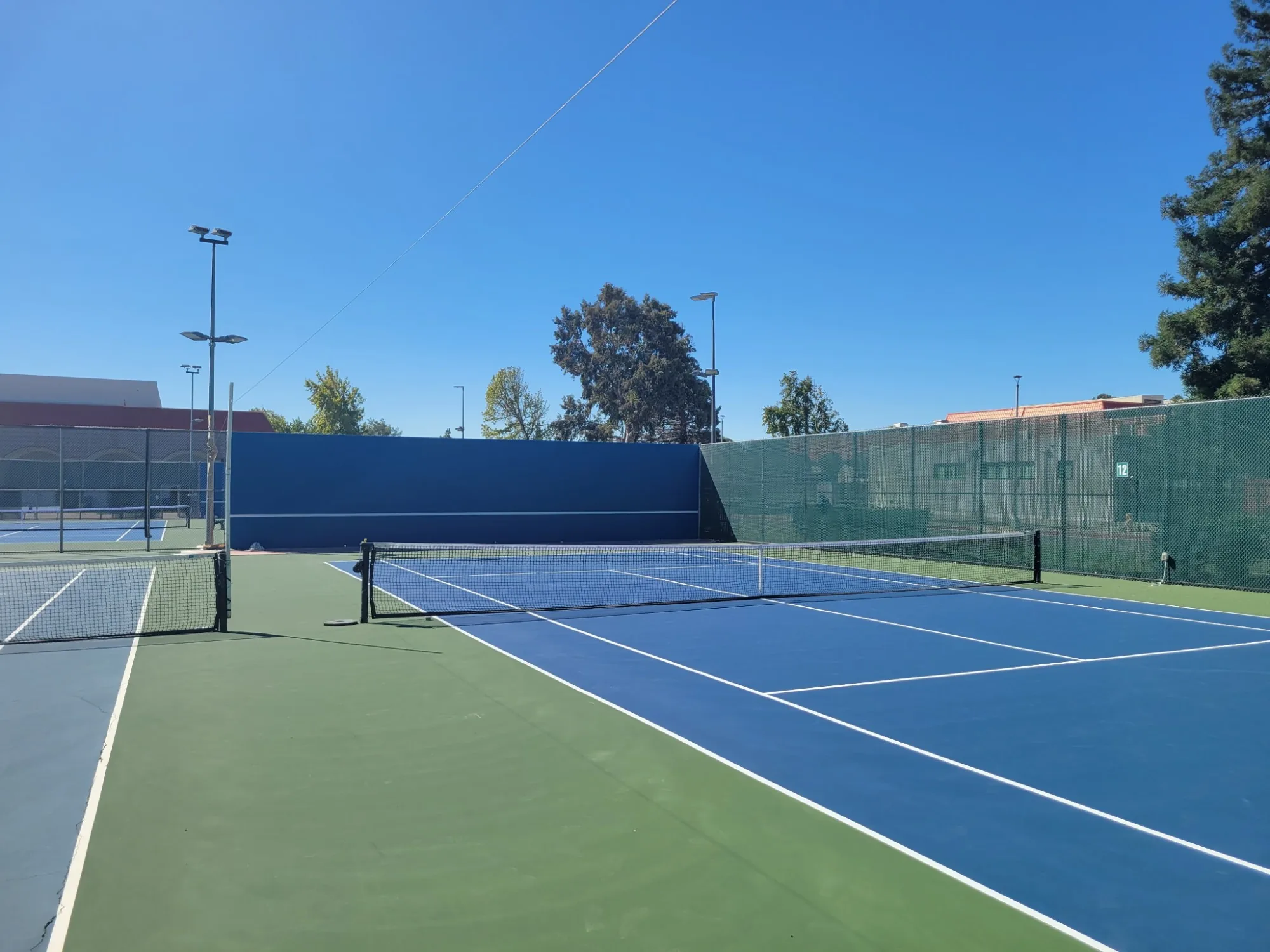
Resurfacing an existing court costs far less than building a new one: typically $5,000 to $15,000, against $20,000 to $45,000 for a brand new court. Converting a tennis court falls in between. Which one fits comes down to a single question: is the pad under your feet still sound?
The Short Answer, Per Court
$5K to $15K
Resurface a sound pad
$10K to $40K
Convert a tennis court
$20K to $45K
Build a new court
Here is how the options compare, what drives the price, and how to decide before you collect bids. Wall 2 Wall handles sports court design, build and resurfacing, so we see all three scenarios in the field.
Five Ways to Get a Court, Plotted
The chart plots typical planning costs per court on one scale, from a quick striping job to a premium build. Each bar shows where the low and high end of the typical range falls.
Typical cost per court
Typical industry planning figures from published 2026 contractor and industry guides, shown to help you compare options. These are not a Wall 2 Wall quote, and California labor and permit costs can run higher than national averages.
Which Path Fits? Three Quick Questions
Start at question one and stop when an answer fits. Each card shows the path, the typical cost per court, and the main thing to watch for.
Is there a pad at all?
$20,000 to $45,000
Site prep, drainage, fencing and lighting add up quickly, and they are what separate a basic court from a premium one.
Is the base still sound?
$5,000 to $15,000
Best for fading, hairline cracks and worn lines. It will not fix a failing base or a heaving slab.
Do you have an unused tennis or basketball court?
$10,000 to $40,000
Far less than a new build, but layout and spacing decide how many courts you really get.
What Pushes a New Build Up
The slab and surface are only part of a new court. Two line items tend to separate a budget build from a premium one:
Site Prep and Grading
$3,000 to $10,000
per court, before any surface goes down
LED Court Lighting
$8,000 to $15,000
per court, installed
Drainage matters more than most owners expect. A court that holds water in low spots wears faster and plays unpredictably, and fixing it after the fact costs more than getting the grade right the first time.
Why One Tennis Court Can Become Several Pickleball Courts
A pickleball court is far smaller than a tennis court, which is why conversions are so popular with HOAs and schools. A doubles tennis court has 2,808 sq ft of playing area, while a pickleball court has just 880 sq ft. Here is what that looks like on the ground:
One tennis court footprint, 120 by 60 feet
Four 30 by 60 foot pickleball spaces fit on one tennis footprint when room is tight. Each blue rectangle is the 20 by 44 foot court, and the lighter border is run-off room.
Four courts is common for casual play. Two courts is the more generous layout, and it is the better choice if you want comfortable run-off, tournament-style play, or room for fencing between courts. We measure your pad before we recommend either.
What Resurfacing Costs Over Time
Resurfacing is a recurring cost, so it helps to see it spread across the years. Acrylic color coats are commonly recoated every 4 to 7 years under hot, heavy-use conditions, and closer to 7 to 10 years in milder settings. Vacaville summers are hot and sunny, so it is safer to plan toward the shorter end.
Yearly cost of keeping a court fresh, on a $10,000 recoat
Those figures use $10,000 as a midpoint for a full resurfacing, so your own number may be lower or higher. The pattern is what matters: a well-built base can last 20 years or more, and the surface on top is what you maintain. Keeping up with the surface is far cheaper than letting it fail and rebuilding the pad underneath.
Signs You Need a Resurface or a Rebuild
Resurfacing is usually enough if
- The color has faded but the surface is still firmly bonded
- Cracks are hairline or small enough to patch
- Lines are worn or you want pickleball lines added
- Low spots are shallow and can be leveled for better drainage
Plan a rebuild if
- The slab is heaving or sinking, often from tree roots or poor soil
- Cracks are wide, spreading or keep coming back through repairs
- Water pools deeply across large areas of the court
- There is no pad at all, only open ground
One Surface, Several Games
Many owners do not have to choose between games. A multi-sport court can carry basketball and pickleball lines on the same surface, with color blocking that keeps each game easy to read. The court below has full basketball hoops at each end, with pickleball lines and a net down the middle.
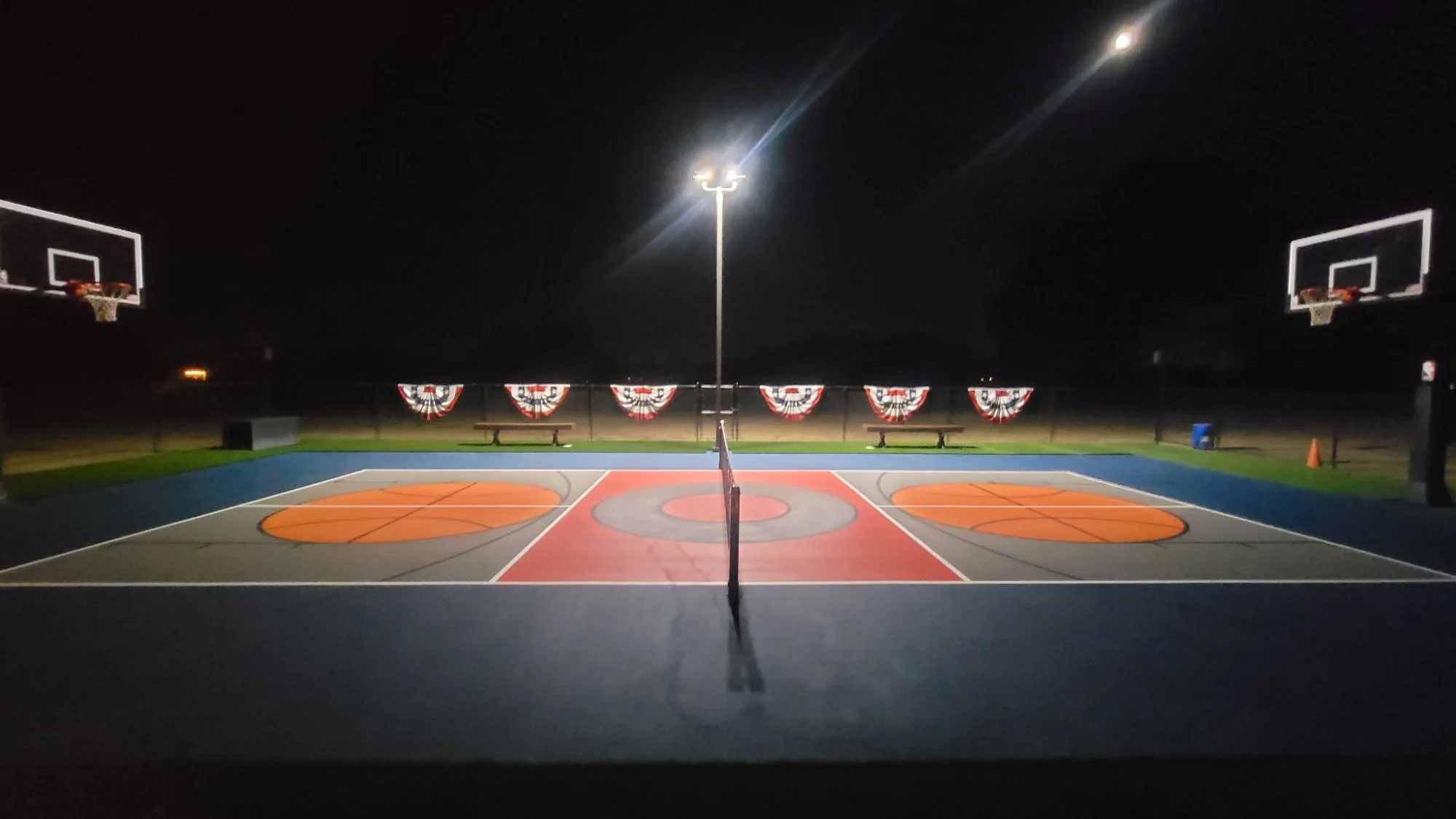
It is a smart way to get more play out of one pad, especially for HOAs, parks and schools that serve a mix of ages and interests.
Court Terms in Plain English
Acrylic color coat
The colored, textured layers on top of the pad. This is the part that fades and wears, and the part resurfacing replaces.
Birdbath
A low spot that holds water after rain. Shallow ones can be leveled during resurfacing. Deep ones may point to a base problem.
Run-off
The open space around the lines so players can chase a ball safely. Pickleball is 20 by 44 feet inside the lines, and 30 by 60 feet with run-off is recommended.
The Bottom Line
If the pad is sound, resurfacing gets you a like-new court for roughly a third of what building new costs. At the midpoints, that is about $10,000 against $32,500. The inspection is what tells you which side of that line your court is on.
Frequently Asked Questions
How much does it cost to build a pickleball court?
Typical industry figures run from about $20,000 to $28,000 for a basic asphalt court and $32,000 to $45,000 for a premium concrete court that is fenced and lit. Site prep, drainage, fencing and lighting are what move the number most, and local labor and permit costs matter too.
Is it cheaper to convert a tennis court to pickleball?
Usually, yes, because the pad already exists. A basic conversion with new lines and nets costs far less than a new build, and the price climbs with fencing, dividers and windscreens. The condition of the existing surface is the biggest variable, so a quick inspection comes first.
How often does an acrylic court need resurfacing?
Most acrylic courts benefit from a full recoat every 4 to 7 years under heavy use and strong sun, and sometimes every 7 to 10 years in milder conditions. Fading, worn lines and slick or rough patches are the usual signs it is time.
Can pickleball lines go on a basketball or tennis court?
Yes. Pickleball lines are commonly striped onto existing tennis and basketball courts, often in a contrasting color so each game stays readable. Whether it works well depends on the size and condition of the pad, which we check before we mark anything.
Sports Courts
Get a Free Court Estimate
Tell us about your court or your space. We will look at the surface and recommend whether to resurface, convert or build.
California State License Board #832068 · Licensed & Insured